
Team, work location or label?
Three ways to structure people and shifts. They are not alternatives to each other: each answers a different question. The wrong choice breaks nothing, but the right one saves work every week.

Three dimensions, three different questions
One workspace equals one employer. Inside it there are three ways to structure your people: a team answers who plans and sees, a work location answers where the work happens, and a label answers what else is worth knowing about a person.
A team scopes visibility and planning
Shifts, planning periods, absences, availability and balancing periods all belong to a team. A manager sees only the teams they have been added to, an admin sees the whole workspace. Automatic scheduling runs for one planning period at a time, and in a workspace with teams a period always belongs to one team.
A work location says where the shift happens
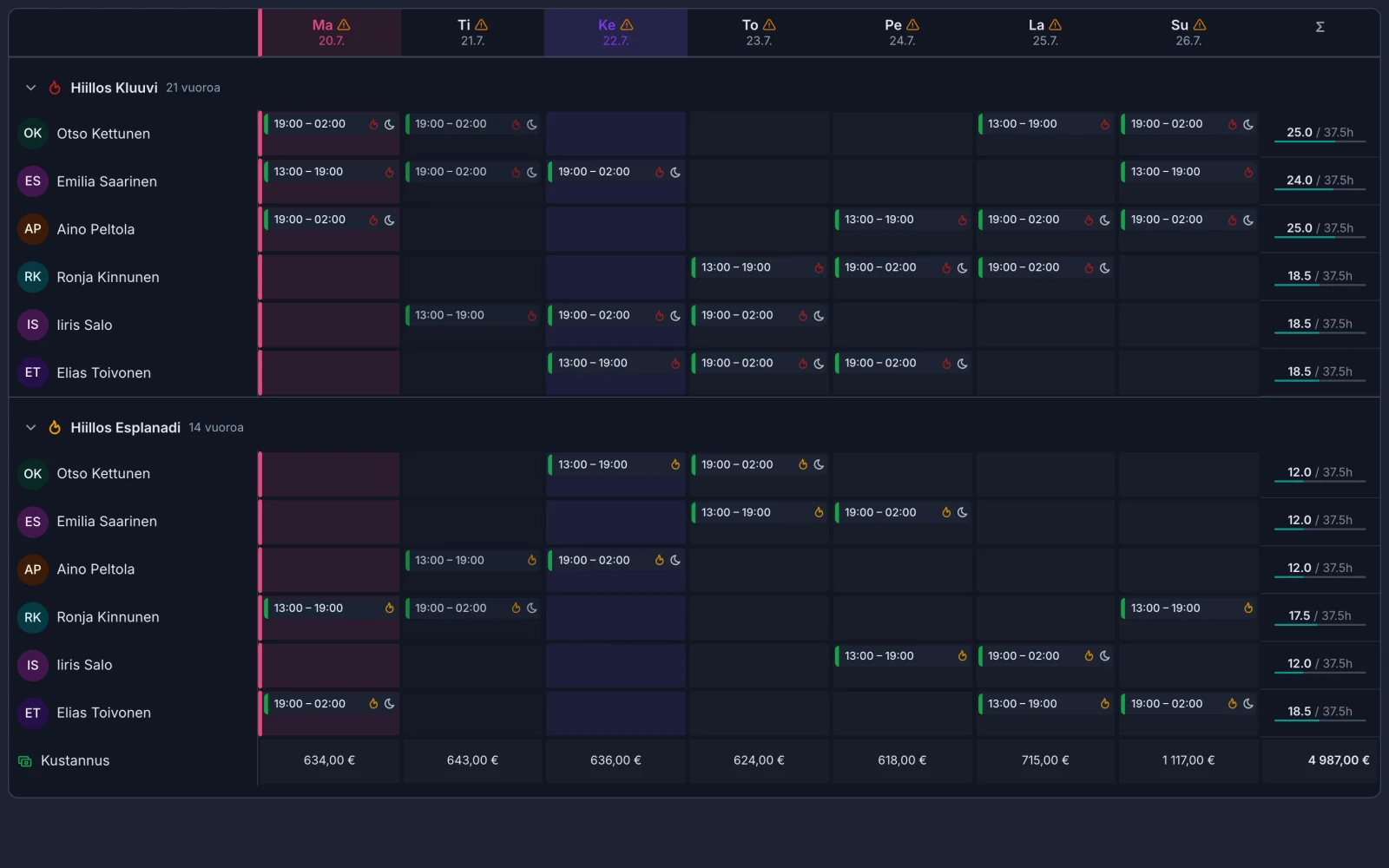
A work location is your own site: a restaurant, a group home or a unit. It is a dimension inside the team, so the same team can rotate between several locations within the same week.
A label is a free-form tag on a person
A label is a pick list whose values you define: seasonal worker, onboarding in progress, has a car. A label never drives planning or payroll. It is a filter that helps you find the right people in a list.
A skill is not a label
Skills have consequences: a statutory skill can block a shift, a skill can expire and a shift can require a minimum level. If the tag needs to affect planning, it belongs to skills. If not, a label is enough.
All three are optional. A single-unit workspace works perfectly without teams and work locations, and both can be introduced later. Shifts created before the first team stay untouched and remain visible in every team, but old planning and balancing periods stay team-less: start a fresh period once you introduce teams.
How to choose
Ask what the tag has to do. If it has to limit visibility or planning, it is a team. If it has to state a place, it is a work location. If it only helps you find people in a list, a label is enough.
A manager may only see their own people
Team. Visibility and planning rights follow team membership, and the team switcher changes the whole view at once.
The same crew rotates between two sites
Work location. One team, two locations: the roster can be grouped by location and on mobile you see at a glance who is where today.
Payroll data must be split by cost center
Work location and its cost center code. The code travels from the shift all the way to the payroll row, and once the row split is switched on in payroll settings, payroll export produces rows per cost center.
I want to filter seasonal workers in a list
Label. A multi-select label works as a filter both in the member list and in scheduling, and it changes no calculation.
A hygiene passport expiry must be tracked
A skill, not a label. Skills have validity dates and can be a precondition for a shift. See the working hours glossary.
How they look in Sutja
The roster can be grouped by work location, so the same team appears as its own section per site. On mobile a location filter shows who is where, and analytics compares locations against each other. Realized figures appear next to the planned ones for periods that have ended, once time tracking is in use.
The order to set things up
Start light and add only when the need is real. Every item is opt-in on its own.
Start without teams if you have one unit. Teams can be added later.
Create a team when a manager must not see other teams’ shifts.
Create a work location for every physical site where shifts are worked.
Give the location a cost center code and switch the row split on in payroll settings if you export per cost center.
Set a home location for each person so scheduling favours shifts at their own site.
Use labels only for information that needs no consequences in planning.
Ready to start?
Shifts handled. You focus on people.
Try Sutja free for 14 days. No credit card, no commitment.